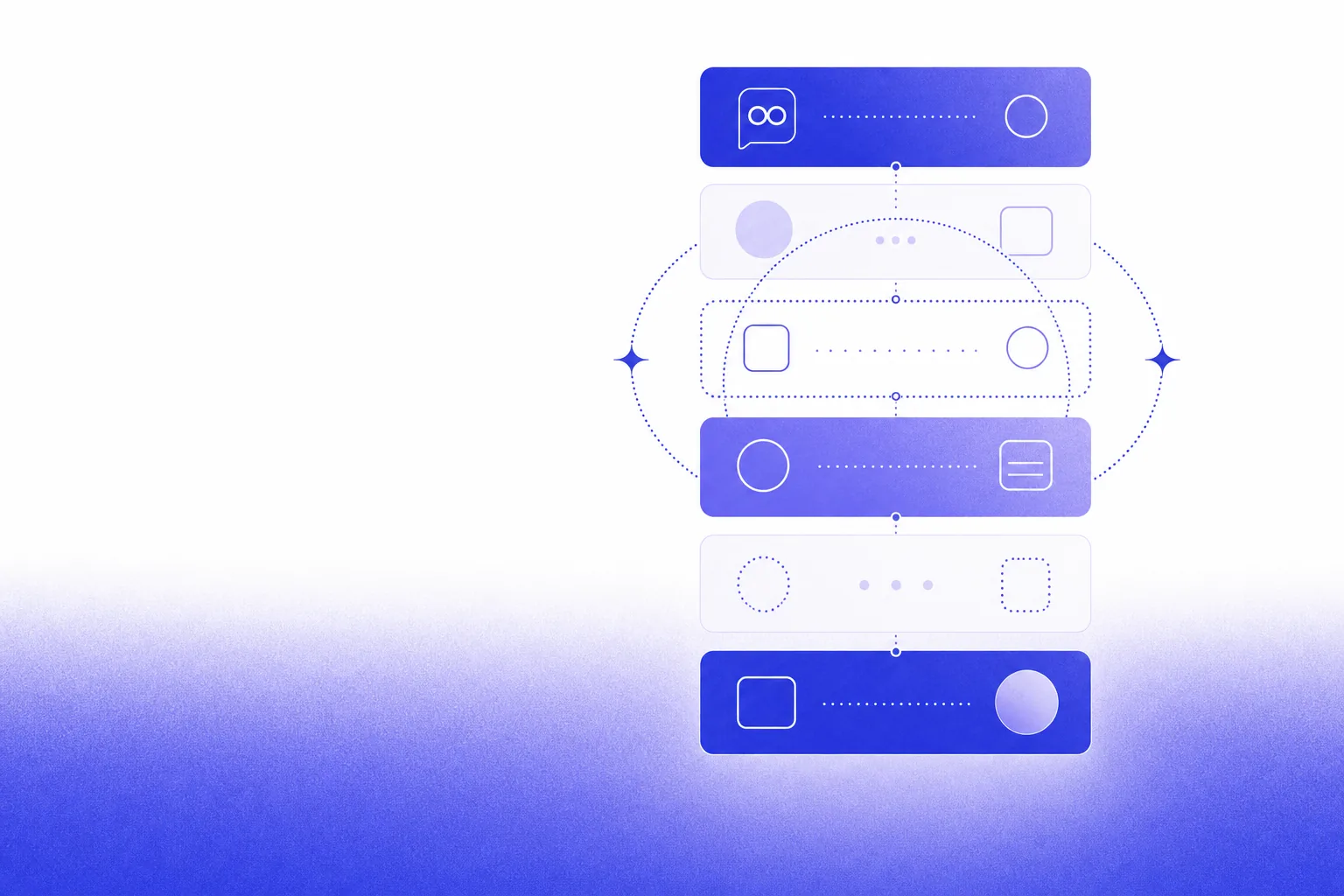
A billing question reaches your support queue. The agent answers from an old help article, cannot check the customer’s account, and offers no way to reach a person. The problem is not the wording alone. It is the customer support chatbot architecture behind the answer. This guide gives SaaS support and CX leads a way to inspect each layer, assign ownership, and reject a design with no clear fallback.
The architecture in one view
Customer support chatbot architecture is the connected set of interface, knowledge, reasoning, action, handoff, and operations layers that turns a customer question into a supported answer or a useful human escalation.
The buyer-level test is simple: can you inspect every layer and name who owns it? If a proposal cannot explain where information comes from, which system performs an action, or what happens when the answer is uncertain, it is not ready for production.
A support lead does not need to build the entire AI stack. You do need to approve the boundaries. The system should make clear where the customer types, which sources the agent may use, when retrieval is enough, how an API action works, what the human receives during a handoff, and which logs show whether the design works.
For a technical reference view, compare this buyer-focused model with Vercel’s customer support agent architecture. The useful question is not whether the diagram looks sophisticated. It is whether your team can operate every box in it.
The six layers a support lead needs to approve
These six layers are the approval surface for a support or CX lead. Review them as connected responsibilities, not as isolated product features. A design is usable only when each layer has an owner, a known input, and a fallback when the normal path fails.
1. Interface layer
This is the customer-facing widget or live-chat surface. It carries the conversation, presents suggested replies, handles language preferences, and provides the point where a customer can request a person.
Identity belongs here too, even if verification happens in your application. A general question about shipping can use public information. An account-specific question needs a trusted identity signal before the agent exposes private data. AssistLoop supports verified user identity through a signed token with a shared secret.
2. Knowledge layer
The knowledge layer contains approved material the agent can use. That may include website content, uploaded files, pasted text, and exact Q&A pairs.
Broad document search works for questions such as “How long does standard shipping take?” Refund rules, cancellation terms, and legal notices may need a direct Q&A pair so the answer does not paraphrase wording your team intended to state precisely.
Ask who approves each source, removes outdated content, and confirms that changes reach the agent. If nobody owns those tasks, the knowledge base will age even when the model stays current.
3. Reasoning layer
The reasoning layer connects retrieval and the language model. Retrieval selects relevant approved content. The model uses that content, the current conversation, and applicable instructions to form a response.
Model choice affects answer quality, speed, and message-credit cost. A short policy lookup may not need the same model as a complicated pre-sales question. A buyer should see the cost before selecting a model.
Retrieval-augmented generation for customer support is useful only when retrieval has a reliable source to find. Calling a design “RAG” does not fix missing policies, duplicate articles, or poorly owned content.
4. Action layer
An answer and an action are different things. A knowledge base can explain your shipping policy. It cannot know where a specific order is unless the system can call an order-status service.
The action layer sends controlled requests to external systems. Common examples include order lookup, lead capture, meeting booking, and account-specific support. Review the REST methods, credentials, inputs, outputs, and failure response for each action. An order lookup should not carry permission to change an order.
5. Handoff layer
Human handoff architecture defines when the agent steps aside and what the human receives. A useful handoff includes the complete thread, customer context, and the reason for transfer. The human should not ask the customer to repeat the problem.
Set triggers for uncertainty, account disputes, sensitive requests, and direct requests for a person. A customer disputing a charge may reasonably need a person even when the policy answer is available.
6. Operations layer
Operations turns conversations into work. Support should be able to review conversation logs, find unanswered questions, inspect handoffs, and connect a failure to a content update, routing change, API fix, or model decision.
Assign ownership before rollout:
| Area | Support or CX | Engineering | Platform vendor |
|---|---|---|---|
| Approved policies and Q&A pairs | Owns approval and updates | Advises on source format | Provides training controls |
| Widget settings and brand voice | Approves customer experience | Supports site integration | Provides widget controls |
| API actions and credentials | Defines the business result | Builds and secures the endpoint | Provides action configuration |
| Handoff rules | Sets customer and topic triggers | Supports identity and routing | Provides inbox and transfer flow |
| Conversation review | Samples answers and handoffs | Fixes application defects | Provides logs and product fixes |
The vendor can operate parts of the infrastructure. It cannot decide whether your refund policy is current or whether a billing dispute should reach a person.
How a customer question moves through the system
Take a common request: “Where is my order?” The customer sends it through the widget. The system identifies that the request needs a specific order record, not only a shipping-policy article. An order-status action calls the approved REST endpoint. The model turns the returned status into a clear answer using the conversation context.
The boundary matters. “Orders usually ship in three business days” is a knowledge question. “Where is order 1842?” is an action question. A system that treats both as document search will give a generic answer or guess.
A follow-up such as “Can I change the address?” should remain connected to the earlier thread. The agent needs to understand that “the order” refers to the same order, while still checking whether the requested change is permitted.
When the source does not support an answer, the agent should say so. It can ask for a missing detail when that detail would resolve the request. If the system still cannot answer, it should offer human handoff instead of inventing a status.
Customer message → Widget → Retrieval or controlled action → Model response → Answer, follow-up, or human handoff
This flow is also described from an implementation-focused angle in Educative’s LLM-powered customer support system design course. For a buyer, the important boundary is the same: retrieval provides approved knowledge, while an action obtains current data from another system.
Where the architecture breaks
Reject any design that guesses when a source is missing. A fluent answer with no supporting source is a failure, not a successful fallback. The agent should state the limit, ask for the missing detail when useful, or offer a human handoff.
Reject designs that use document retrieval for account-specific work. A shipping article can explain a policy. It cannot verify an order, change an address, or confirm a customer’s plan. Those tasks need an action, identity controls, and a defined response when the endpoint fails.
Reject handoffs that discard the thread. A transfer that makes the customer start again moves the work to a human without preserving the useful context. The receiving team needs the conversation, customer context, and reason for transfer.
Reject dashboards that report volume without showing what went wrong. Support needs conversation logs, unanswered questions, handoff topics, and action outcomes. Without them, nobody can tell whether the fix belongs in the knowledge base, a handoff rule, an API, or the model.
What good looks like in measurable terms
Use definitions before targets. For deflection, choose a denominator and keep it fixed. One practical definition is the share of eligible conversations resolved without human handoff. Do not count every closed chat as a successful answer. Review a sample of conversations classified as deflected and check whether the customer received a supported answer.
For an initial launch review, use a 100-conversation sample. Label each conversation as a supported answer, appropriate human handoff, unanswered request, or action failure. Set a local approval target of at least 90 conversations with either a supported answer or an appropriate handoff. This is an operating target for your team, not an industry benchmark.
Manually review at least 20 conversations from each high-volume topic before expanding scope. If four or more of those 20 conversations contain an unsupported answer, stop adding traffic to that topic and update the source, exact Q&A pair, or handoff rule first.
Track human handoff rate by topic. A high rate for billing or account questions may show a sensible boundary. Repeated handoffs for a basic shipping policy point to missing or unclear training content. Record the topic, reason, and outcome rather than treating every handoff as a failure.
Measure action success separately from answer quality. For the first action, review 20 successful and failed attempts where possible. Record successful responses, missing records, timeouts, and errors as different outcomes. An agent can explain the order-status process accurately while the lookup fails.
Use unanswered questions as a queue. Each item should lead to one decision: add an approved source, write an exact Q&A pair, change a handoff rule, or leave the scope unchanged because the agent should not answer it. These review thresholds are a starting method, not a claim about universal SaaS performance.
Last verified: September 2026.
What to check before you approve any architecture
Use these checks in a design review. Ask for a live walkthrough instead of accepting a feature list.
Knowledge checks. Can your team control sources, add exact Q&A pairs, retrain after a content change, and identify the source behind an answer?
Action checks. Can the system call required REST endpoints with scoped credentials? What does the customer see when an endpoint times out, returns no record, or returns an error?
Handoff checks. Can a customer reach a person mid-chat? Does the receiving human get the full thread and useful context? Test this after several follow-up messages.
Operations checks. Can Support review conversations, find unanswered questions, measure deflection, and connect failures to a training update?
Cost and capacity checks. How are message credits counted? Do credits roll over? Can the team choose a model after seeing its cost? AssistLoop pricing lists current plan and message-credit details.
Last verified: September 2026.
Trust checks. Does the design state what the agent cannot do? Does it protect account-specific data through verified identity? Are roadmap capabilities clearly separated from available features?
Where managed support agents fit
A managed support agent combines services a team might otherwise assemble separately: the widget, knowledge ingestion, retrieval, model configuration, shared inbox, and action controls. That can reduce the number of systems you connect and maintain. It does not remove the need for source ownership, handoff rules, identity checks, or conversation review.
The buyer should own approved content, escalation rules, actions, brand settings, and review. The managed platform operates the product layer around them. Treat that split as part of the architecture.
AssistLoop lets you train the agent on your knowledge base using files, website content, pasted text, or exact Q&A pairs, then embed the agent through a widget. Exact Q&A pairs suit sensitive answers that should not be broadly paraphrased. Approved website content and files can cover wider support questions.
When a person needs to take over, human handoff sends the full thread and available context to the team in a shared inbox. The agent does not need to resolve every issue. It needs to recognize its boundary and transfer the conversation cleanly.
Agent Actions let the agent call REST endpoints, capture leads, book meetings, or check order status in the conversation. Each action still needs an owner, scoped credentials, and a defined failure response.
AssistLoop is not the right fit if your rollout requires WhatsApp, Telegram, Instagram, or Messenger today. Those channels are coming soon rather than available now.
The operating signals that tell you the design is working
After the launch sample, turn findings into a named weekly queue for the first four weeks. Support owns content changes and handoff decisions. Engineering owns endpoint failures and identity defects. The platform vendor owns product defects and configuration issues.
For each issue, record the conversation ID, topic, layer, owner, and next action. Close the item only when the relevant test passes again. This keeps a failed API lookup from being mistaken for a knowledge problem and keeps a missing policy from becoming a model-tuning task.
Once the first four weeks are complete, keep the same review definitions and repeat the sample monthly. Change the cadence only after the team can explain who owns each layer and what happens when the normal path fails.
A rollout sequence for a SaaS support team
- Start with stable questions. Choose repeat questions with approved answers, such as plan rules, setup instructions, or published policies. Leave account-specific actions out until identity and API behavior are clear.
- Add and test the sources. Upload approved material, add exact Q&A pairs, and test the wording customers use. Include incomplete questions and follow-up messages.
- Publish the escape route. Configure the widget and human handoff before launch. A customer who receives an uncertain answer needs a visible path to a person.
- Connect one action. Choose a single task with a clear success response and failure response. Log both outcomes.
- Review before expanding. Read early conversation logs, remove unsupported claims, and expand scope only when the team can explain who owns each layer.
Review AssistLoop pricing for current message-credit and plan details before choosing capacity. Credits and limits can change, so treat the live pricing page as the source of truth.
Last verified: September 2026.
When the first scope is clear, create an AI agent and test the architecture with a small set of real support questions. The goal is to prove that every answer has a source, every action has a boundary, and every uncertain conversation has somewhere useful to go.
FAQ
What is customer support chatbot architecture?
Customer support chatbot architecture is the connected design of the interface, knowledge sources, reasoning model, actions, human handoff, and operations. A usable design explains how a question becomes a supported answer or a clear transfer to a person.
Where does retrieval fit in a support agent?
Retrieval sits between the customer request and the model response. It selects relevant approved content, while a separate action or API call is needed when the answer depends on current account or order data.
When should an AI support agent hand off to a human?
Handoff should occur when the customer requests a person, the source does not support a reliable answer, the request involves sensitive account or billing issues, or an action fails. The human should receive the full conversation and useful context.
Can a support agent take actions through an API?
Yes, a support agent can call a controlled REST endpoint for tasks such as order lookup, lead capture, or meeting booking. The design should define scoped credentials, successful responses, and a safe customer-facing fallback when the endpoint fails.

Written by